Biography
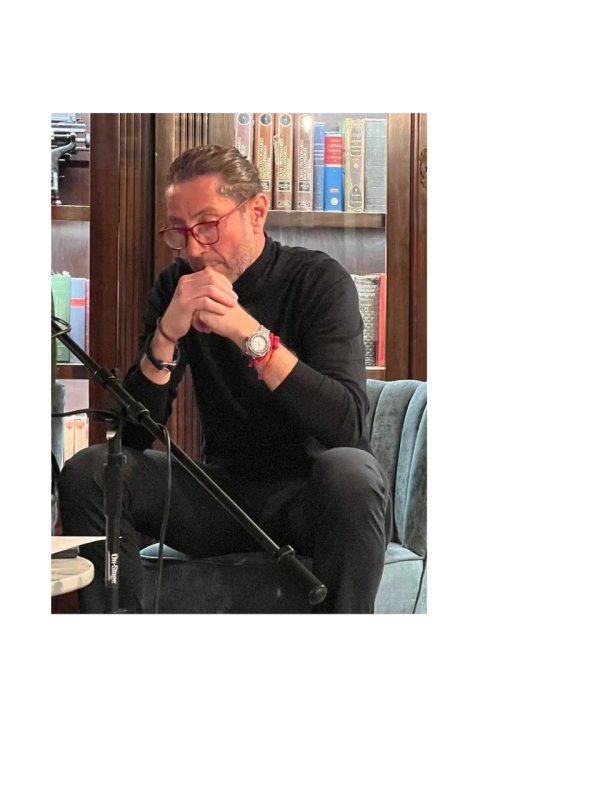
Lawyer and writer. Santiago de Chile, 1970.
I have developed a long professional career across different countries and fields. Within that practice, I have sought to introduce elements of poetic sensibility into my work, which has ranged from drafting contracts and legal briefs to opinions and legislative projects.
From there, I turned to writing once I found a voice of my own — one that felt sufficiently formed to be expressed through poetry.
I have published two books with Valparaíso Ediciones, in Granada, Spain.
I am the father of three children, who have also been a source of creative inspiration.
I am currently working on a new book, as well as on a film screenplay which will develop de experience of a young Swiss soldier durin the COVID pandemics.
What do my books explore?
My writing emerges at the intersection of experience and inquiry. It does not seek to assert, but to explore: to open a space in which poetry may operate as a form of knowledge, even if always partial, always in tension.
I write from a situated consciousness, shaped by time, personal history, and the transformations of a culture that tends to dissolve the individual. In this context, poetry becomes an attempt to sustain a voice of one’s own, while recognising that such a voice is never entirely one’s own: it gathers, translates, and reshapes what also belongs to others.
My work moves across different registers, from a denser and more fragmented language to a more direct expression grounded in images. This movement does not arise from rupture, but from a search: each book explores a distinct way of approaching the same underlying concern.
At its core, that concern is the question of the individual — of freedom, fragility, and the possibility of meaning within an environment that often exceeds it. Poetry, in this sense, does not provide answers, but allows one to inhabit the questions more fully.
I do not understand writing as an isolated exercise. I believe in a poetry that enters into circulation, that engages with ordinary life, that does not demand adherence or reverence, but offers itself as an open experience.
If something of that experience resonates with the reader — however slightly, however briefly — the gesture finds its justification.

Fermento
Fermento is a collection that, at times, adopts a cryptic language, while seeking to distil and engage with the finest tradition of twentieth-century Chilean poetry.
It moves through the interstices of a consciousness that is at once out of time and firmly situated. From this vantage point, it addresses themes ranging from love to social questions, as well as the evolution of a hypermodern culture. The question of the individual runs throughout the collection, probing the pain that arises from a lack of direction and meaning, and the anxiety of singular existence within a globalised world that tends to reduce the individual to a consumer, a functional unit within an economy in which he himself carries little intrinsic value.
The poems attempt to bear personal witness to a self that experiences its own transience and lack of transcendence, without a clear connection to any shared historical horizon.
In this context, the individual often appears as a secondary figure within his own existence, unable to escape the disorientation of finding himself among a multiplicity of isolated lives.
Thus, the question of freedom — and of the self’s present awareness — ceases to stand as a stable value, and instead becomes an open inquiry, one that finds expression only as a form of lived sensation, anchored in being present rather than in being.

Fragilidad
Following the surprise that Fermento was — even to myself — I continue my path with Fragilidad. In this book, I have renewed my poetic voice, moving somewhat away from the more cryptic and surreal language of Fermento, towards a language richer in imagery and more transparent in its expression.
The themes of Fragilidad traverse a range of experiences and images; however, these pages are permeated by a persistent sense of vulnerability — of the father, of the individual, of society, of existence, and of love. It is this underlying fragility that gives the collection its name.
The book also includes a number of poems that explore the vulnerability inherent in the experience of fatherhood, from both perspectives: that of the father and that of the child. I would highlight the long poem Al Decir de Chile, conceived as a father’s song to his children, who have left their lives in this country to begin a form of “return” — not only geographical — towards the Switzerland that underlies their everyday existence. In this poem, one may perceive echoes of Canto General by Neruda, alongside a cadence that recalls Zurita, in a subtle dialogue with that tradition.
There is also a more deliberate engagement with the great Chilean poets, understood here as one of the country’s most significant contributions to the wider cultural and artistic world, in dialogue with its diverse and untamed landscape.
Finally, Fragilidad speaks from a first-person experience that brings together the social and the ontological. Within this intersection, the question of the self — and of freedom, not as an abstract idea but as something that might be lived — remains open.
To be anounced

The new book is in its final stage of development. It is still unpublished. The title remains a surprise. Most likely, the book will be submitted to a very prestigious literary competition, which could delay its publication until the end of 2026.
Are we truly free? Does free will exist? Is consciousness merely an illusion generated by the brain? Can there be love without freedom? Are we anything more than a set of electrochemical processes we call life? What is hope? What becomes of what has already been? Does it make sense to speak of destiny?
The book situates itself within this field of questions. It begins from an intuition: that the present may be nothing more than a fleeting perception, sustained by a consciousness that experiences itself as free, yet is shaped by multiple and often opaque determinations. A consciousness that perceives itself, but never fully understands itself.
Within this framework, the present becomes elusive. When we attempt to grasp it, it has already passed. The senses arrive too late. Time does not pause, and the universe continues its indifferent expansion.
We inhabit that movement. Something carries us forward, though we cannot fully name it.
Albedrío does not seek to resolve these questions. It approaches them through poetic experience, assuming that every answer is partial, provisional. Rather than asserting, the book proposes a sensation: that of estrangement before what is most familiar, of a self that does not fully recognise itself in what it lives.
In this sense, the poems move between lightness and dislocation, in proximity to what might be called Dasein: a presence that is, yet does not possess itself.
The book brings together a number of poems from earlier work that already gravitated around these ideas, alongside new texts that, in part, return to a more tense and compact language, closer to the register of Fermento.
Prelude in the Alps
During the COVID-19 pandemic in Switzerland, a young army recruit is assigned to remove the bodies of elderly residents who have died in nursing homes in the Canton of Bern. After discovering a piano in one of those homes, he begins to play after each “extraction”. As music restores dignity and presence to those awaiting the end, a troubling paradox emerges: for the music to return, someone must die.
The young man meets a retired piano teacher who teaches him to play not merely with flawless technique, but with the emotion that springs from life itself and finds expression through breath. Confronted with loss, silence and breath itself, the soldier is drawn into an unexpected and introspective coming of age. In parallel, a candid bond with a nurse reveals that love need not be an anchor, but can instead become a portal to new horizons and quiet hope.
.png/:/)
Poems
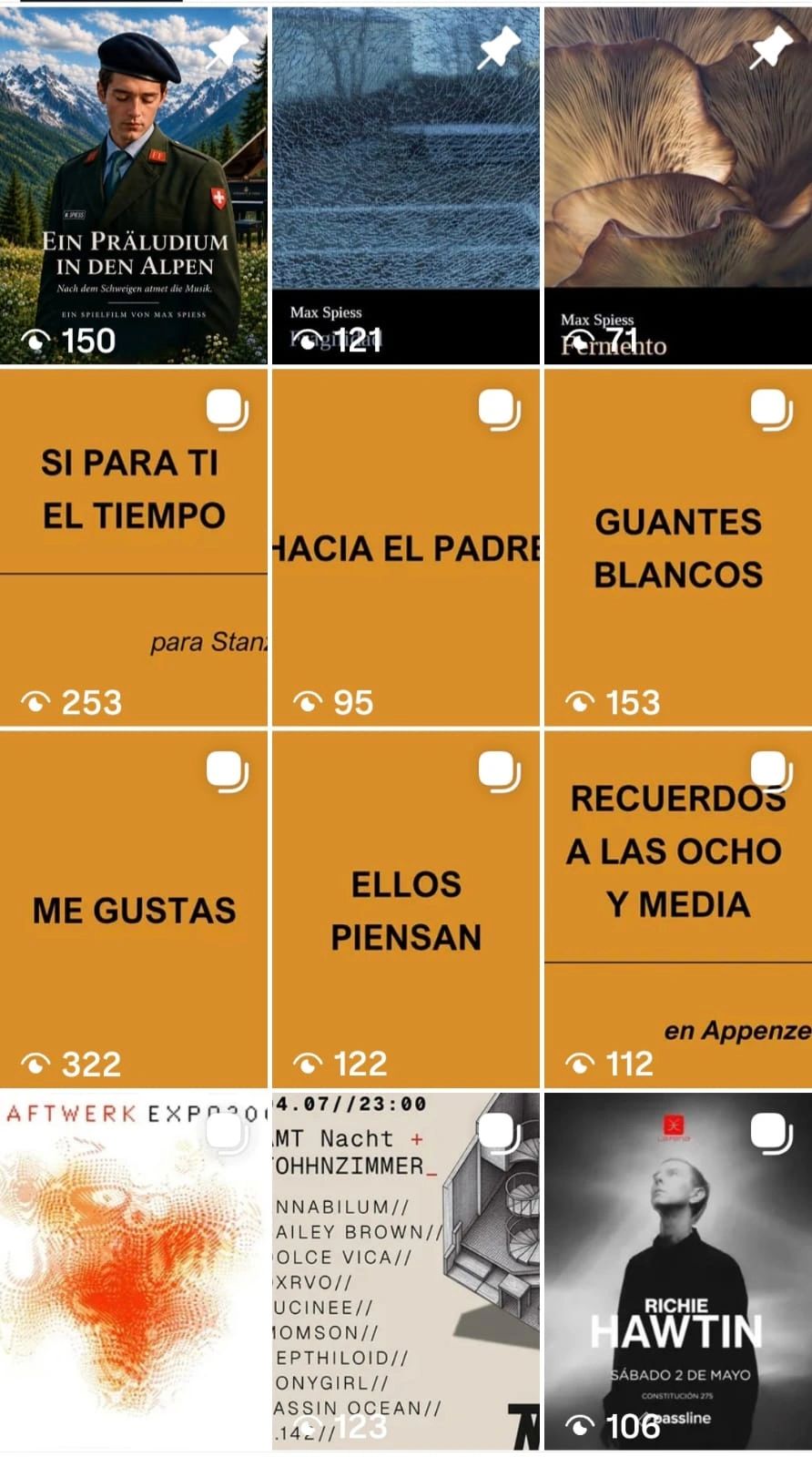
I invite you to read some of my work on my Instagram profile, @maxspiess. Feel free to share your thoughts and leave a comment; and if anything you read resonates with you, I’d be delighted if you left a “like”.